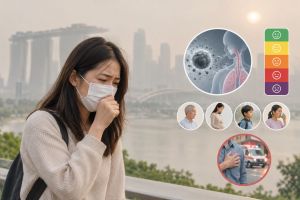

Yes, haze can affect your breathing. The fine particles in haze irritate the nose, throat and airways, and can cause coughing, a sore throat and mild breathlessness. Most healthy adults recover once air quality improves. See a GP if a cough or wheeze lasts more than a few days, your asthma or chronic lung condition flares, or breathing feels harder than usual.
Key takeaways
- Singapore reports air quality using the 24-hour Pollutant Standards Index (PSI), published by the National Environment Agency (NEA) on haze.gov.sg.
- The PSI bands are Good (0 to 50), Moderate (51 to 100), Unhealthy (101 to 200), Very unhealthy (201 to 300) and Hazardous (above 300).
- Fine particles called PM2.5 are the main concern in haze because they are small enough to reach deep into the lungs.
- Older adults, pregnant women, children and people with heart or lung conditions are more likely to feel unwell during haze.
- Severe breathlessness, chest pain or blue lips need emergency care: call 995.
How does haze affect your lungs and breathing?
Haze irritates the lining of your airways, which can trigger coughing, throat discomfort and tightness in the chest. The main culprit is PM2.5, particulate matter 2.5 micrometres or smaller, which is fine enough to travel past your nose and into the lungs.
In Singapore, haze episodes are usually linked to land and forest fires in the region, and they have tended to occur around the southwest monsoon period, roughly June to October. How much the haze affects you depends on how bad the air is, how long you are exposed and your own health.
Common symptoms include:
- Itchy or watery eyes
- Runny or blocked nose, and sneezing
- Sore or scratchy throat
- Dry cough
- Mild breathlessness, especially during exercise
- Headache or feeling tired
For most people these symptoms are short-lived and settle once the air clears. The picture is different if you already have a lung or heart condition, which we cover below.
What do NEA’s PSI readings mean for your health?
The 24-hour PSI is Singapore’s official measure of air quality, and it tells you how much outdoor activity is sensible. NEA also publishes 1-hour PM2.5 readings, which are useful for planning activities over the next few hours.
The table below combines NEA’s PSI bands with the Ministry of Health’s (MOH) general activity advice.
24-hour PSI | Band | Healthy adults | Older adults, pregnant women, children | People with chronic heart or lung disease |
|---|---|---|---|---|
0 to 50 | Good | Normal activities | Normal activities | Normal activities |
51 to 100 | Moderate | Normal activities | Normal activities | Normal activities |
101 to 200 | Unhealthy | Reduce prolonged or strenuous outdoor exertion | Minimise prolonged or strenuous outdoor exertion | Avoid prolonged or strenuous outdoor exertion |
201 to 300 | Very unhealthy | Avoid prolonged or strenuous outdoor exertion | Minimise outdoor activity | Avoid outdoor activity |
Above 300 | Hazardous | Minimise outdoor activity | Avoid outdoor activity | Avoid outdoor activity |
For the 1-hour PM2.5 readings, NEA uses four bands: Normal (0 to 55 µg/m³), Elevated (56 to 150), High (151 to 250) and Very high (251 and above). You can check both readings on haze.gov.sg or the myENV app before heading out.
Who is more likely to have breathing problems during haze?
People whose lungs or heart are already under strain feel the effects of haze sooner and more strongly. That includes:
- People with asthma or chronic obstructive pulmonary disease (COPD, a long-term lung condition often linked to smoking)
- People with heart disease
- Adults aged 65 and above
- Pregnant women
- Young children, who breathe faster and spend more time active outdoors
- People with allergic rhinitis (a sensitive, easily irritated nose), who may notice more sneezing and congestion
If you are in one of these groups, plan ahead when the PSI is forecast to rise. Make sure you have enough of your usual medicines at home, and speak to your doctor early if your symptoms are harder to control than usual. If you have long-term conditions such as high blood pressure or diabetes, a routine health screening is also a good time to review your overall health.
How can you protect your breathing on hazy days?
The simplest steps are to cut down your exposure and keep indoor air cleaner. You do not need to stay indoors all day when the PSI is in the Moderate band, but it makes sense to adjust once it enters the Unhealthy range.
- Check the PSI each morning and before exercise or outdoor plans.
- Move workouts indoors or reschedule them when readings are high.
- Close windows and doors when the haze is noticeable, and use air-conditioning if you have it.
- Use an air purifier with a HEPA filter in the room where you spend the most time, such as the bedroom. Choose one correctly sized for the room.
- Drink water regularly to keep your throat comfortable.
- Keep taking your usual medicines, including asthma preventer inhalers, and carry your reliever inhaler.
- Consider a mask for longer outdoor exposure. For short trips, most healthy people do not need one. If you must be outdoors for a long time when air quality is unhealthy, an N95 mask filters fine particles far better than a surgical mask, but it can feel harder to breathe through, so check with your doctor first if you have a heart or lung condition.
When should you see a GP about haze symptoms?
See a GP when symptoms last more than a few days, keep getting worse, or affect your sleep, work or daily activities. A GP can listen to your chest, check your oxygen level, review your inhalers and look for other causes, such as a chest infection. Lung and throat infections are among the common problems our GPs see.
Book a GP consultation if you notice:
- A cough that has not improved after several days, or keeps you up at night
- Wheezing (a whistling sound when you breathe) or chest tightness
- Feeling short of breath with everyday activities such as climbing stairs
- Needing your asthma reliever inhaler more often than usual
- A fever, or coloured phlegm, which may point to an infection rather than haze alone
- Nose and eye symptoms that do not settle even when you stay indoors
If your symptoms are mostly sneezing, a runny nose and itchy eyes that keep coming back, your GP may suggest allergy testing to see whether dust, pollen or other allergens are adding to the problem.
When is it an emergency?
Some symptoms need immediate care and should not wait for a clinic appointment. Call 995 or go to the nearest emergency department if you or someone with you has:
- Severe breathlessness, or difficulty speaking in full sentences
- Chest pain or pressure
- Blue or grey lips or fingertips
- Confusion, fainting or unusual drowsiness
- An asthma attack that does not ease after using a reliever inhaler
For milder symptoms, check our opening hours and contact details and message the clinic to arrange a visit.
Frequently asked questions
Haze itself does not cause infection, but irritated airways may be less able to clear germs. If you develop a fever, coloured phlegm or feel generally unwell, see a doctor, as this could be a separate respiratory infection that needs assessment.
When the 24-hour PSI is Good or Moderate, normal outdoor exercise is fine for most people. Once it reaches Unhealthy (101 and above), healthy adults should reduce prolonged or strenuous outdoor exercise, and people in higher-risk groups should cut back further or move indoors.
For a short walk, most healthy people do not need an N95 mask. Masks are more useful if you have to be outdoors for long periods when the PSI is high. People with heart or lung conditions should check with their doctor before using an N95 mask, as it can make breathing feel harder.
Schools follow Ministry of Education guidance on haze and adjust outdoor activities as needed. At home, keep children indoors during high readings and watch for coughing, wheezing or breathlessness, especially if they have asthma.
Eye, nose and throat irritation usually eases within a day or two of air quality improving. If a cough or breathlessness lasts longer than that, or you have a long-term lung condition that has become harder to control, see a GP.
This article is for general information only and is not a substitute for medical advice. Please consult a qualified doctor in Singapore for advice specific to your situation.